98d766ae-62b2-49c9-bf32-e349fd6a2311

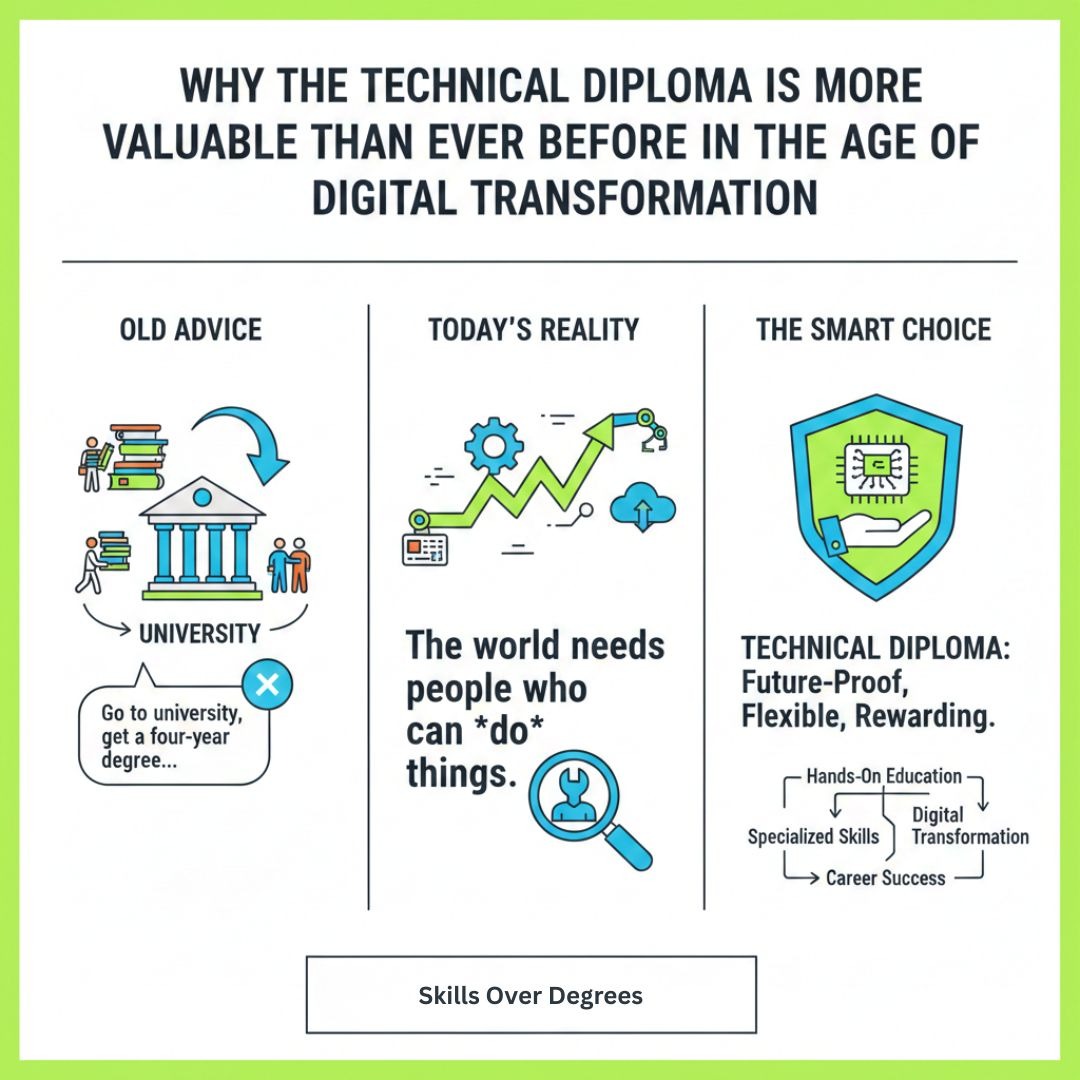
Why the Technical Diploma is More Valuable Than Ever Before in the Age of Digital Transformation

We have all heard the old advice. For decades, parents and teachers repeated the same mantra: “Go to university, get a four-year degree, and your future is set.” For a long time, that was the safest path. But if you look around today, the world feels different. Technology is moving at a breakneck speed, industries are shifting overnight, and the job market is no longer looking for people who just “know” things; it is looking for people who can *do* things.

This is where the **Technical Diploma** comes in. As we are going through the complex era of Digital Transformation, the value of specialized, hands-on education is skyrocketing. It is no longer the “Plan B” for those who didn’t go to university. Instead, it is becoming the smart, strategic choice for anyone who wants a career that is future-proof, flexible, and financially rewarding.

In this piece of writing, we are going to break down why a technical diploma might just be the most valuable asset you can own right now, and how it fits perfectly into our modern, digital world.

The Speed of Tech vs. The Speed of Degrees

Imagine you buy a brand-new smartphone. It’s the latest model, incredibly fast, and has all the best features. Now, imagine you put that phone in a drawer and don’t touch it for four years. When you finally take it out, is it still the best? Probably not. The apps won’t run properly, the operating system is outdated, and the camera quality lags behind the new standard.

This is the challenge facing traditional four-year degrees today. By the time a curriculum is approved, textbooks are written, and students complete their freshman through senior years, the technology they studied in their first semester might already be obsolete.

Technical diplomas operate differently. They are like software updates; fast, targeted, and designed to fix immediate problems. For you, this means you enter the workforce with skills that are fresh and in demand right now, not skills that were relevant five years ago. You aren’t learning the history of the engine; you are learning how to fix the electric motor that Tesla just released.

Employers Are Craving “The Doers”

There is a concept in the corporate world known as the “skills gap.” It sounds like fancy business jargon, but it is actually a very simple problem. Companies have plenty of open jobs, and there are plenty of unemployed people, but the two aren’t matching up.

Why? Because employers are struggling to find people who can hit the ground running.

When a company is going through a digital transformation, perhaps moving their data to the cloud or automating their manufacturing line, they don’t necessarily need someone who can write a ten-page thesis on the theory of cloud computing. They need someone who knows how to configure the server, troubleshoot the network, or program the robotic arm.

A technical diploma focuses entirely on application. It strips away the electives and general education requirements that, while enriching, don’t help you troubleshoot a server crash on a Tuesday morning. This practical approach makes diploma holders incredibly attractive to hiring managers. When you walk into an interview and can show a portfolio of projects you have actually built, fixed, or designed, you instantly have an edge over a candidate who has only studied the theory.

Agility in a World of AI and Automation

One of the biggest fears people have today is Artificial Intelligence (AI). We see headlines claiming that robots will take our jobs. While it is true that AI can write basic emails or generate images, it cannot easily replace the hands-on, nuanced work of a skilled technician.

Digital transformation isn’t about replacing humans; it’s about humans working *alongside* advanced technology.

Think about a modern hospital. They use incredibly complex, automated MRI machines and digital record systems. But who maintains those machines? Who troubleshoots the software when it glitches during a scan? Who secures the patient data against hackers?

Technical diplomas position you to be the person who manages the technology. When you learn a trade or a specific technical skill, you become the bridge between the digital tool and the real world. Automation requires *more* maintenance, *more* programming, and *more* cybersecurity oversight, not less. By securing a diploma in these fields, you are essentially “robot-proofing” your career. You become the master of the machine, rather than the person the machine replaces.

The Flexibility to Pivot

The days of having one career for 40 years are gone. In the digital age, you might change careers five or six times. You might start in web development, move into user experience (UX) design, and eventually transition into digital project management.

Because technical diplomas are shorter and more focused, they allow for “stackable credentials.” This is a strategy where you don’t commit to a massive block of education all at once. Instead, you get a diploma, enter the workforce, and learn. Three years later, you notice the industry is shifting toward data analytics. You can go back, take a six-month specialized diploma in analytics, and pivot your career without having to start a whole new four-year degree.

However, this fast-paced lifestyle of continuous learning and career shifts requires high emotional intelligence. When you are constantly adapting to new roles or upgrading your skills while working, it is easy for the lines between “professional growth” and “personal time” to blur. Learning the art of setting personal boundaries at work is essential during these transitions to ensure that your drive to stay relevant in the digital age doesn’t lead to exhaustion.

This approach allows you to build a career that looks like a Lego set; adding pieces as you go, based on what the market needs and what you enjoy. It is a much more natural way to navigate a working life that is constantly being disrupted by new technologies.

It’s Not Just About “Tech” Jobs

When we say “Technical Diploma,” most people immediately think of coding or IT support. While those are huge parts of it, digital transformation has touched *every* industry.

  • Healthcare: Medical tech is booming. We need technicians to operate 3D printers for prosthetics, manage telehealth platforms, and maintain diagnostic equipment.
  • Automotive: Mechanics aren’t just changing oil anymore; they are essentially computer engineers working on electric vehicles with millions of lines of code.
  • Construction: Modern drafting is done with CAD software and 3D modeling. Green energy requires certified technicians for solar and wind installation.
  • Creative Arts: Graphic design, video editing, and sound engineering are all technical fields that rely on complex software suites.

A technical diploma is the key to unlocking these modern versions of traditional roles. It provides the specific digital fluency required to operate in these updated industries. For further reading on how industries are evolving, the Harvard Business Review frequently discusses the changing nature of work and the skills required.

Breaking the “University or Bust” Stigma

For a long time, there was a stigma that vocational or technical education was “lesser than.” Society pushed the narrative that smart people go to university, and everyone else goes to trade school.

The digital age has shattered that illusion. Today, some of the smartest, most successful people are those who bypassed the traditional route to focus on specialized skills. In the tech world, nobody cares about your pedigree; they care about your repository. In the creative world, nobody asks for your transcript; they ask for your portfolio.

We are seeing a cultural shift where “competence” is valued over “credentials.” Large companies like Google, Apple, and IBM have even removed college degree requirements for many of their top positions. They are looking for skills, and a technical diploma is often the most direct proof that you possess them.

Final Thoughts: Your Future is Practical

The world is noisy and confusing right now. Technology changes every day, and it can feel overwhelming to decide what path to take. But if you strip away the noise, the answer is often quite simple: **Learn a skill that solves a problem.**

That is the essence of the technical diploma. It is grounded in reality. It is a commitment to learning something tangible, useful, and immediately applicable. In an age of digital transformation, where everything is becoming virtual, the value of the person who can actually build, fix, and maintain the systems we rely on has never been higher.

So, if you are standing at a crossroads, wondering if a shorter, specialized education is “enough,” stop worrying. It is not just enough; it might be the smartest move you can make. It is your golden ticket to a career that is resilient, adaptable, and ready for whatever the future holds.

By: Muhammad Arif Hossain

F&B-min

A Culinary Pathway in Bangladesh’s Growing Hospitality Sector

A Culinary Pathway in Bangladesh’s Growing Hospitality Sector

Beyond serving, the heart of any successful hotel or restaurant lies in its food and beverage production. In Bangladesh, where culinary traditions are rich and diverse, skilled professionals in this area are in high demand.

  • Training and Opportunities:
    • Short courses focusing on culinary techniques, food safety, and beverage preparation are readily available in Dhaka, Chittagong, and other major cities.
    • These programs equip individuals with the skills to work as chefs, cooks, bakers, and beverage specialists in hotels, restaurants, and resorts across Bangladesh.
    • With the rise of international cuisine and the growing popularity of Bangladeshi delicacies among tourists, there’s a strong need for chefs who can blend traditional flavors with modern techniques.
    • Training in areas such as Bangladeshi cuisine, continental cuisine, and pastry and baking are all available.
  • Earning Potential:
    • Chefs and cooks can earn competitive salaries, with opportunities for advancement to sous chef and executive chef positions.
    • Specialized roles like pastry chefs and beverage specialists also offer attractive earning potential, especially in high-end establishments.
    • The rise of tourism in areas like Cox’s Bazar, and Sylhet has increased the demand for skilled workers in food and beverage production.
  • Local Relevance:
    • Focus on local ingredients and culinary traditions is crucial.
    • Understanding the preferences of both domestic and international tourists is essential.
    • Knowing how to prepare traditional Bangladeshi food is a great way to increase your income.

Training Opportunity:

  • Bangladesh Skill Development Institute (BSDI):
    • BSDI offers a range of vocational training programs, including courses in culinary arts, baking.
    • Their programs emphasize practical skills development, aligning with industry standards and preparing students for immediate employment.
    • BSDI focuses on providing skills that are needed in the current job market, and has a strong focus on practical training.
    • They have modern facilities and experienced instructors.
    • Courses are designed with internship placement. 

Earning Potential:

  • Entry-level cooks and bakers can earn competitive salaries, with opportunities for advancement to higher positions.
  • Specialized roles like pastry chefs and beverage managers offer attractive earning potential, especially in high-end establishments.

F&B-min

Tourism & Hotel Management Career in Bangladesh

Short Training, High Earnings

Bangladesh’s tourism sector is experiencing a remarkable surge, creating a plethora of exciting career opportunities. If you’re passionate about hospitality and seeking a fast track to financial stability, consider a career in tourism and hotel management. And the best part? You don’t need years of formal education. Focused, short professional training can pave the way to a rewarding and lucrative career right here in Bangladesh.

Why the Bangladesh Tourism Sector is Booming

The Bangladesh tourism sector growth is undeniable. From the world’s longest unbroken sea beach in Cox’s Bazar to the serene tea gardens of Sylhet, and the mysterious Sundarbans, Bangladesh offers a diverse range of attractions. This surge is fueled by:

  • Increased Domestic Tourism: More Bangladeshis are exploring their own country, leading to higher demand for hospitality services.
  • Growing International Interest: Bangladesh is gaining recognition as a unique travel destination, attracting tourists from around the world.
  • Government Initiatives: The government is actively promoting tourism, investing in infrastructure, and supporting hospitality training.

This growth directly translates to a surge in tourism jobs in Bangladesh and a strong demand for skilled professionals in the hotel industry jobs Bangladesh.

Your Gateway: Hospitality Training Bangladesh

Besides the lengthy degree, You can easily start any short, impactful training programs. This is your key to entering this thriving industry. These programs are specifically designed to:

  • Provide practical, hands-on skills relevant to the hospitality context.
  • Offer industry-specific knowledge, including local tourism regulations and cultural sensitivity.
  • Enhance employability through internships and placements with local hotels and tour operators.
  • Offer specialized certificates in high-demand areas, like Food and Beverage Production, Bakery and pastry, Food and Beverage Service, front office, Housekeeping, bartending courses Bangladesh, restaurant management training Bangladesh, and tour guide training Bangladesh.

If you are looking for hotel management courses in Dhaka, or other major cities, there are many reputable institutions offering hospitality training Bangladesh. Many people are finding great success after they complete vocational training for tourism Bangladesh.

High-Demand Roles and Earning Potential in Bangladesh

Here are some roles you can pursue with short professional training, along with their earning potential in the Bangladeshi context:

  • Front Desk Agent: The first point of contact for guests, crucial in ensuring a positive experience. Earning potential: Competitive salary, with opportunities for advancement in major hotels in Dhaka, Chittagong, and other tourist hubs.
  • https://bsdi-bd.org/hmc/front-office-management/
  • Food & Beverage Production: 

A Tasty Career in Bangladesh Bangladesh’s booming hospitality needs skilled chefs and cooks. Short courses offer training in culinary skills, food safety, and beverage prep. Jobs abound in hotels and restaurants, with good earning potential. Focus on local cuisine and tourist preferences for best results.

  • Food and Beverage Service:  
  • Providing exceptional dining experiences in restaurants and hotels. Earning potential: Hourly wages plus tips, with significant earning potential in popular tourist areas like Cox’s Bazar and Sylhet.
  •  https://bsdi-bd.org/hmc/food-beverage-services/
  • Tour Guide: Leading groups on adventures in destinations like the Sundarbans, Bandarban, and Saint Martin’s Island. Earning potential: Daily rates plus tips, with higher earnings during peak tourist seasons. Tour guide training Bangladesh is becoming increasingly popular.
  • Bartender: Crafting cocktails and providing excellent service in bars and restaurants. Many people are attending bartending courses Bangladesh to increase their income. Earning potential: Hourly wages plus tips, with high earning potential in popular nightlife areas.
  • Hotel Housekeeping Supervisor: Ensuring cleanliness and hygiene in hotels. Earning potential: Salary, with potential for advancement to higher management roles.
  • https://bsdi-bd.org/hmc/house-keeping-operation/
  • Restaurant Manager: Overseeing operations of restaurants. A lot of people are finding well paying jobs in the hotel industry jobs Bangladesh. For those interested in the food and beverage industry, there are many opportunities for restaurant management training Bangladesh. Earning potential: Salary, with potential for increases based on experience.

Navigating Your Career Path in Bangladesh

  • Choose Reputable Training: Look for programs with industry partnerships and experienced instructors.
  • Focus on Practical Skills: Prioritize hands-on training and internships.
  • Network Locally: Attend industry events and connect with professionals in your region.
  • Embrace Local Culture: Understanding Bangladeshi culture is crucial for providing excellent hospitality.
  • Stay Updated: The tourism industry is dynamic; continuous learning is essential.

Your Journey Begins NowThe Bangladesh tourism sector growth is creating unprecedented opportunities. Explore hotel management courses in your area of Bangladesh and start your journey today! Search for tourism jobs in Bangladesh on local job boards and online platforms. Find hospitality training Bangladesh near you. With dedication and the right training, you can build a successful and fulfilling career in the vibrant tourism and hotel management industry of Bangladesh.

ED Sir (2)-min

Daffodil Polytechnic Institute Hosts Spectacular Spring Festival, Embracing CulturalHeritage

Daffodil Polytechnic Institute ushered in the spirit of spring with its grand celebration of the Basant Utsav 1430. Held on the institute’s sprawling campus grounds on 16th Falgun, 29th February, the event captivated attendees with a vibrant showcase of Bengali traditions and cultural festivities.

One of the highlights of the day-long event was the Pitha Mela, featuring a colorful array of traditional Bengali pitha/cake from all 64 districts of Bangladesh. Additionally, stalls adorned with rural Bengali cultural motifs added to the immersive experience, showcasing the rich heritage of Gram Bangla.

The festivities commenced with a colorful procession from the campus grounds, heralding the start of the Basant Utsav. Following this, the main ceremony was inaugurated by the CEO of the Daffodil Dr. Mr. Mohammad Nuruzzaman and The principal Mr. K. M. Hasan Ripon.
The campus was transformed into a floral paradise, adorned with flowers, banners, and local crafts, all reflecting the essence of Bangladeshi culture and rural traditions. Students actively participated in various cultural performances throughout the day, including dance, music, and poetry recitations, all dressed in vibrant traditional attire.


The joyous atmosphere permeated throughout the event, with both faculty and students alike immersed in the celebration. The Basant Utsav not only celebrated the arrival of spring but also served as a platform to foster unity and entrepreneurial spirit among the youth.It underscores Daffodil Polytechnic Institute’s commitment to holistic education and cultural preservation.

ক্যাম্পাস প্রাঙ্গণে দিনব্যাপী বসন্ত উৎসবে মাতোয়ারা ড্যাফোডিল পলিটেকনিকের শিক্ষার্থীরা 

ঋতুরাজ বসন্তকে ঘীরে ড্যাফোডিল পলিটেকনিক ইন্সটিটিউটে আয়োজিত হয়েছে বসন্ত উৎসব-১৪৩০। ১৬ই ফাল্গুন, ২৯ ফেব্রুয়ারি  ড্যাফোডিল পলিটেকনিকের নিজস্ব ক্যাম্পাস প্রাঙ্গণে এই আয়োজন করা হয়। দিনব্যাপী এই আয়োজনের অন্যতম আকর্ষণ ছিলো পিঠা মেলা।  উৎসবে স্থান পেয়েছে বাংলাদেশের ৬৪ জেলার ঐতিহ্যবাহী বাহারি সব পিঠা, স্টল গুলোও সাজানো হয় গ্রাম-বাংলার সংস্কৃতিকে ধারন করে। ড্যাফোডিল পলিটেকনিক হয়ে উঠেছিলো সমগ্র বাংলাদেশের প্রতিচ্ছবি।  সকালে ক্যাম্পাস প্রাঙ্গন থেকে বর্ণীল শোভাযাত্রার মাধ্যমে উৎসবের শুরু হয়। পরবর্তীতে ফিতাকেটে মূল অনুষ্ঠানের উদ্ভোদন করেন ড্যাফোডিল ফ্যামিলির সম্মানিত সিইও ড. মোহাম্মাদ নুরুজ্জামান ও ড্যাফোডিল পলিটেকনিকের অধক্ষ্য জনাব কে এম হাসান রিপন। 

বসন্ত উৎসবকে ঘীরে ক্যাম্পাসকে সাজানো হয় ফুল, বাশ বেত দিয়ে দেশীয় সংস্কৃতি ও গ্রামীণ ঐতিহ্যে। শিক্ষার্থীদের অংশগ্রহণে আয়োজন করা হয় নাচ, গান, কবিতা আবৃত্তিসহ নানা সাংস্কৃতিক অনুষ্ঠান। শিক্ষার্থীদের বর্ণীল পোশাকে ক্যাম্পাস হয়ে উঠেছিলো রঙিন। দিনব্যাপী এই আয়োজনে আনন্দ উচ্ছ্বাসে একইসাথে মেতে উঠেছিলো শিক্ষক ও শিক্ষার্থীরা। উৎসবটি সকলের জন্য উন্মুক্ত ছিলো। বসন্ত ঋতুকে ঘিরে বাঙালি জাতির বহু বছরের যে উৎসাহ উদ্দীপনা তার সাথে তরুণ প্রজন্মের শিক্ষার্থীদের মিল্বন্ধন তৈরি করতে এবং শিক্ষার্থীদের মাঝে উদ্যোক্তা মনোভাব গড়ে তুলতে এই আয়োজন অত্যন্ত গুরুত্বপূর্ণ বলে মনে করেন ড্যাফোডিল পলিটেকনিকের কর্মকতা-কর্মচারীগণ।

football_tournament3

Daffodil Polytechnic Institute Int. Departmental Football Tournament-2024

রুদ্ধশ্বাস প্রতিযোগিতার মধ্য দিয়ে ড্যাফোডিল পলিটেকনিক ইন্টাঃ ডিপার্টমেন্ট ফুটবল টুর্নামেন্টে টিম ইম্পায়র ইলেক্ট্রিক্যাল ইউনাইটেড ১ঃ০ গোলে চ্যাম্পিয়ন। 

২৭ ফেব্রুয়ারি ড্যাফোডিল স্মার্ট সিটিতে ঝমঝমাট উদ্ভোধনী অনুষ্ঠানের মাধ্যমে ড্যাফোডিল পলিটেকনিক ইন্সটিটিউটের সম্মানিত অধ্যক্ষ্য জনাব কে এম হাসান রিপন  টুর্নামেন্টের উদ্ভোধন করেন। 

৬টি ডিপার্টমেন্ট থেকে বাছাইকৃত ৬টি দলের সমন্বয়ে টানটান ৬টি ম্যাচের মাধ্যমে সম্পূর্ণ টুর্নামেন্টি অনুষ্ঠিত হয়। এসময় সকল ডিপার্টমেন্টের শিক্ষার্থী এবং শিক্ষকমন্ডোলীগন উপস্থিত থেকে খেলোয়াড়দের অনুপ্রাণিত করে। 

 টুর্নামেন্টে রানার্স আপ হয় টিম কম্পিউটার টাইটান্স। 

খেলা শেষে চ্যাম্পিয়ন এবং রানার্স আপ টিমের হাতে ট্রপি তুলে দেন প্রধান অতিথি মোহাম্মাদ মামুন মিয়া, সাবেক প্লেয়ার, জাতীয় ফুটবল টিম। এছাড়াও প্রতিটি দলের সেরা খেলোয়াড়কে মেডেল প্রদান করা হয়। 

খেলাধূলা শিক্ষার্থীদের শারীরিক এবং মানসিক বিকাশে অত্যন্ত গুরুত্বপূর্ণ। টুর্নামেন্টে শিক্ষার্থীগণ অত্যন্ত উৎসাহ উদ্দীপনায় খেলায় অংশগ্রহণ করে এবং খেলা উপভোগ করে এবং এই টুর্নামেন্ট শিক্ষার্থীদের মধ্যে সৌহার্দ্য এবং ক্রীড়াপ্রীতির জাগিয়ে তোলে।

Daffodil Polytechnic Institute Int. Departmental Football Tournament-2024

In a thrilling competition, Team Empire Electrical United emerged as champions in the Daffodil Polytechnic Institute Departmental Football Tournament, securing victory with a score of 1-0.

On February 27th, amidst much fanfare, the inauguration ceremony of the tournament took place at Daffodil Smart City. The principal of Daffodil Polytechnic Institute, Mr. K M Hasan Ripon, graced the occasion with his presence and officially inaugurated the tournament.

The tournament featured six carefully selected teams representing six departments, who competed in six exciting matches to complete the entire tournament. The presence of students and faculty members from all departments added to the fervor of the event, inspiring the players on the field.

The runners-up title went to Team Computer Titans after a series of intense matches. At the conclusion of the games, the chief guest, former national football team player Mr. Mohammad Mamun Mia, presented the championship trophy and medals to both the champions and the runners-up.

It is worth mentioning that sports play a vital role in the physical and mental development of students. The tournament provided an excellent platform for students to showcase their talents, boost their morale, and enjoy the spirit of sportsmanship.

Overall, the tournament was a resounding success, fostering a sense of camaraderie and sportsmanship among the students and faculty members of Daffodil Polytechnic Institute.

Milestones of Aspiration: Daffodil Polytechnic Institute Students Illuminate the 53rd Victory Day with Dreams of Progress

On 16th December In a dazzling display of national pride and unwavering spirit, Daffodil Polytechnic Institute orchestrated a triumphant celebration on December 16th, marking the hallowed Victory Day in Bangladesh. This grand commemoration not only paid homage to the historic triumph of 1971 but also showcased the institute’s commitment to fostering creativity, reflection, and holistic well-being.

The decorated rally started from Academic Building 1 to Academic Building 2 and ended.The jubilation commenced with an exhilarating rally, a majestic procession that saw a united front of students, faculty, and staff, adorned in the resplendent colors of the national flag, marching with unparalleled enthusiasm across the institute grounds. The crescendo of this display was the heart-stirring Flag-Raising Ceremony, where the national flag ascended to the morning sky a poignant tribute to the hard-fought victory that birthed the sovereign nation of Bangladesh. During this time the students and teachers sing the national anthem and simultaneously the national flag is hoisted.

Highlighting the occasion were two luminaries—Freedom Fighter Nazir Ahmed (Sector No. 4, Beanibazar, Sylhet, Gazette 44), a living legend and eyewitness to the struggle for independence, and Eng. Azharul Islam, the esteemed former Principal of Dhaka Polytechnic and Daffodil Polytechnic Institute. Their inspirational keynote addresses seamlessly intertwined personal narratives with historical context, underscoring the pivotal role of education in preserving the spirit of liberation.The freedom fighter said that where your campus is standing today was not like that during the war of 1971,the days of that time were very horrible procession of corpses continued everyone was worried but we had courage in our hearts this confidence that our conviction was the attitude which drove us forward.

As a token of gratitude, the institute bestowed flowers and crests upon these distinguished speakers, symbolizing profound appreciation for their invaluable contributions to the collective memory of Victory Day.


Taking the celebration beyond symbolism, Career Launchpad organized a free health check-up campaign, embodying the institute’s unwavering commitment to the holistic well-being of its vibrant community. Medical professionals and volunteers rendered essential health services, turning the celebration into a tangible demonstration of care and compassion. On 14th & 16th December, Career Launchpad specifically organized a free health checkup for students and teachers, extending their benevolence to emphasize a lot for poor people as well.

The campus pulsated with creative energy as students participated in an exhilarating art and essay competition, challenging their intellectual and artistic prowess. The themes centered around the profound essence of Victory Day, promoting a deeper understanding of historical significance while fostering a culture of creativity and expression.

Echoing the spirit of Victory Day, the Students of DPI adorned its walls with a powerful testament – a tapestry of red-green handprints symbolizing unity and national pride.

The cultural extravaganza that followed was nothing short of a visual and auditory feast, featuring poetry recitations, musical performances, and dance routines that transcended the boundaries of artistic expression. Students showcased their talents, painting an evocative picture of patriotism through the rhythmic flow of words, harmonies of songs, and graceful movements of dance.

The day reached its zenith with a dazzling prize-giving ceremony, an opulent affair that recognized and celebrated the outstanding contributions of participants in the art and essay competition. Certificates of appreciation were distributed, serving as tangible symbols of the institute’s recognition of the dedication and effort put forth by every participant.

At the event’s conclusion, the air resonated with the echoes of victory songs, composed with heartfelt fervor, creating a powerful ambiance. The dual environment of patriotic self-development talks and instilling compassion among students to love their country added an enriching layer to the festivities, underscoring Daffodil Polytechnic Institute’s dedication to nurturing a generation that not only celebrates its history but actively contributes to the flourishing future of the nation.

Event Video

As the sun gracefully set on the Victory Day celebrations at Daffodil Polytechnic Institute, the echoes of patriotic expressions, the vibrant hues of the national flag, and the creative fervor lingered in the air. This monumental day was not merely a commemoration; it was a resounding promise to honor the sacrifices of the past, nurture the talents of the present, and inspire a future generation that carries the torch of liberation and progress.

Remembering the Sacrifice: Daffodil Polytechnic Institute Observe Martyr Intellectual Day With Cognitive & Humanity Practice

On 14th December 2023 Daffodil Polytechnic Institute, a beacon of academic excellence, observed the solemn occasion of Shaheed Buddhijibi Dibosh on December 14th, focusing on humanizing students and fostering knowledge, in line with its commitment to holistic education. The institute acknowledges the profound importance of Martyred Intellectuals Day in the life of the nation, a day that carries immense historical and cultural significance.

Shaheed Buddhijibi Dibosh pays tribute to the 1,111 intellectuals who sacrificed their lives during the Liberation War of 1971, embodying the enduring spirit of Bangladesh’s pursuit of knowledge and freedom. Daffodil Polytechnic Institute recognizes the crucial role intellectuals play in shaping the destiny of a nation and celebrates this day every year with great dignity.

This year’s commemoration featured various activities designed to deepen student’s understanding of the sacrifices made by intellectuals during the war. In addition to academic pursuits, the institute’s commemorative event aimed to instill a deep sense of humanity in its students, emphasizing the importance of character development and social responsibility.

Amidst the activities, it is crucial to reflect on the profound importance of Martyred Intellectuals Day. This day serves as a poignant reminder of the sacrifices made by individuals who laid down their lives for the ideals of knowledge, freedom, and national sovereignty. It is a testament to the indomitable spirit of intellectualism that continues to shape the nation.

Daffodil Polytechnic Institute proudly hosted all activities dedicated to National Intellectual Day, further reinforcing its commitment to acknowledging and honoring the sacrifices made by intellectuals during the Liberation War of 1971. By being the venue for these significant activities, the institute played a pivotal role in creating an environment for reflection and remembrance.

In conjunction with the commemorative event, Daffodil Polytechnic Institute organized various programs to deepen students’ understanding of the role of intellectuals in society. An impromptu essay writing competition engaged students in exploring the documentation of the self-sacrifice of intellectuals, fostering a thoughtful and introspective atmosphere.

Students, as part of their engagement, carefully watched the documentary related to National Martyrs Intellectual Day on December 14th and wrote summaries from their own intellectual thoughts, adding a layer of personal reflection to the commemorative activities.

The institute’s belief in humanizing students extends to their overall well-being. Understanding the importance of health in the life of an intellectual, free health checkups were arranged on December 14th and 16th through the Career Launchpad initiative.

More than 700 students, teachers, and underserved individuals participated in the health checkups, emphasizing the institute’s commitment to the holistic development of its community.

Daffodil Polytechnic Institute remains steadfast in its mission to produce intellectually sound and socially responsible individuals who contribute positively to society and the nation. By commemorating Martyred Intellectuals Day, the institute reinforces its dedication to creating an environment where knowledge is not only gained for the students but also ensures the betterment of humanity.

Screenshot 2023-10-18 at 10.11.21 AM

Implement AWS Academy in the Diploma Sector in Bangladesh

The world is increasingly becoming digital, and cloud computing has emerged as a pivotal technology that drives this transformation. In today’s interconnected and data-driven world, the demand for cloud computing skills is soaring. As a result, educational institutions are seeking ways to equip students with the knowledge and skills necessary to thrive in this digital age. Amazon Web Services (AWS), with its AWS Academy program, presents an incredible opportunity to bridge the skills gap in the diploma sector in Bangladesh.

History of AWS

Amazon Web Services (AWS) has a rich history that has transformed the way organizations and individuals access and utilize computing resources. Founded in 2006, AWS began as a subsidiary of Amazon.com, Inc. and quickly emerged as a leader in the cloud computing industry. AWS’s journey can be summarized in a few key milestones:

-2002 : The platform was launched

-2003 : Concept was reformulated with standardized plans

-2004 : The first service (Simple Queue Service) launched for public usage

– 2006: AWS is officially launched, offering cloud computing services that include storage, computing, and databases.

– 2010: The introduction of Amazon Virtual Private Cloud (Amazon VPC) enhances network security and connectivity in the cloud.

– 2012: AWS GovCloud is introduced to support government agencies and organizations with strict compliance requirements.

– 2013: AWS offers its first-ever certification, the AWS Certified Solutions Architect – Associate, marking the beginning of its certification program.

– 2015: AWS Lambda is launched, providing serverless computing capabilities.

– 2017: AWS announces the Deep Learning Amazon Machine Image (AMI) for artificial intelligence and machine learning workloads.

– 2020: The launch of AWS Outposts allows customers to run AWS infrastructure on-premises, extending the AWS cloud to their data centers.

– 2021: AWS continues to innovate with services like Amazon SageMaker, a fully managed machine learning service, and the AWS Nitro System, which powers EC2 instances for enhanced performance and security.

Today, AWS is a global leader in cloud services, serving millions of customers worldwide, including startups, enterprises, public sector organizations, and individuals.

AWS Academy History

The AWS Academy program is an initiative by AWS to bridge the skills gap in cloud computing. The program was designed to equip educational institutions with the resources and support needed to teach cloud computing effectively. Here’s a brief history of AWS Academy:

2017: AWS Academy was officially launched, aiming to provide educators with AWS-authorized curriculum, hands-on labs, and faculty training resources.

2018: The AWS Academy program expanded its reach, partnering with educational institutions globally to offer cloud computing courses.

2019: AWS Academy introduced an accreditation program for educators, allowing them to become AWS Academy Accredited Instructors, ensuring high-quality instruction.

2020: The program continued to grow, with more institutions incorporating AWS Academy courses into their curricula and offering students the opportunity to earn AWS certifications.

2021: AWS Academy maintained its commitment to addressing the demand for cloud skills by updating and enhancing its curriculum, preparing students for real-world cloud challenges.

Today, AWS Academy serves as a vital bridge between educational institutions and the cloud computing industry. It enables students to acquire in-demand cloud computing skills and prepares them for AWS certifications, opening doors to exciting career opportunities.

AWS Products and Services

AWS offers almost 200 plus a vast array of cloud computing products and services to cater to the diverse needs of organizations and individuals. Some of the core AWS services and product categories include:

1. Compute Services: 

   – Amazon EC2 (Elastic Compute Cloud) for scalable virtual servers.

   – AWS Lambda for serverless computing.

   – Amazon ECS (Elastic Container Service) for container management.

2. Storage and Databases:

   – Amazon S3 (Simple Storage Service) for object storage.

   – Amazon RDS (Relational Database Service) for managed databases.

   – Amazon DynamoDB for NoSQL database management.

3. Networking:

   – Amazon VPC (Virtual Private Cloud) for network isolation.

   – Amazon Route 53 for domain name system (DNS) web services.

   – AWS Direct Connect for dedicated network connections.

4. Security and Identity:

   – AWS Identity and Access Management (IAM) for access control.

   – AWS Key Management Service (KMS) for encryption key management.

   – AWS Certificate Manager for SSL/TLS certificates.

5. Machine Learning and Artificial Intelligence:

   – Amazon SageMaker for building, training, and deploying machine learning models.

   – Amazon Rekognition for image and video analysis.

   – Amazon Polly for text-to-speech conversion.

6. Developer Tools:

   – AWS CodeCommit for source code management.

   – AWS CodeBuild for continuous integration.

   – AWS CodeDeploy for automated deployment.

7. Analytics:

   – Amazon Redshift for data warehousing.

   – Amazon EMR (Elastic MapReduce) for big data processing.

   – Amazon Quicksight for business intelligence and data visualization.

8. Internet of Things (IoT):

   – AWS IoT Core for IoT device connectivity.

   – AWS IoT Greengrass for IoT edge computing.

   – Amazon FreeRTOS for embedded microcontroller devices.

9. Containers and Serverless:

   – Amazon EKS (Elastic Kubernetes Service) for container orchestration.

   – AWS Fargate for serverless container management.

   – AWS App Runner for building and running containerized web applications.

10. Migration and Transfer:

    – AWS Snowball for data migration.

    – AWS Database Migration Service for database migrations.

    – AWS DataSync for data transfer to and from AWS.

These are just a fraction of the services AWS provides, and the AWS ecosystem continues to expand to meet the evolving needs of the cloud computing industry. AWS’s global reach, reliability, and extensive service offerings make it a dominant force in cloud technology.

The Need for Cloud Computing Skills

As the world shifts towards digitalization and cloud-based services, the demand for cloud computing expertise is growing across industries. Businesses are looking for cloud professionals who can architect, manage, and secure cloud infrastructures. This demand extends to Bangladesh, where companies are adopting cloud solutions to stay competitive and agile in the modern business landscape.

AWS Academy: A Solution to Bridge the Skills Gap

The AWS Academy program is designed to address the growing demand for cloud skills by providing educators with the resources to teach cloud computing effectively. By integrating AWS Academy into the diploma sector in Bangladesh, institutions can equip students with the knowledge and hands-on experience required to meet industry demands. Here’s why AWS Academy is a game-changer:

1. Comprehensive Curriculum: AWS Academy offers a comprehensive curriculum that covers cloud computing, storage, database, networking, and more. It prepares students to tackle real-world challenges by providing them with a deep understanding of AWS services and best practices.

2. Hands-On Labs: Practical experience is essential for mastering cloud computing. AWS Academy provides access to hands-on labs that allow students to apply their knowledge by working with AWS services in a controlled environment.

3. Industry-Recognized Certifications: With AWS Academy, students have the opportunity to earn AWS certifications, such as AWS Certified Solutions Architect (Associate and Professional), AWS Certified Developer, and more. These certifications are highly regarded by employers and can significantly enhance students’ job prospects.

4. Faculty Development: AWS Academy offers resources for faculty development, ensuring that educators are well-equipped to teach cloud computing effectively. This empowers them to deliver high-quality education to their students.

5. Connection to the Industry: Through AWS Academy, educational institutions can establish connections with AWS and its extensive network of partners. This can lead to internship opportunities, guest lectures, and collaboration on research projects.

Benefits for Students

Introducing AWS Academy into the diploma sector in Bangladesh can bring a host of benefits to students:

Enhanced Career Prospects: AWS-certified professionals are in high demand globally. Graduates with AWS Academy training will be well-positioned to secure high-paying jobs in the cloud computing industry.

Hands-On Experience: The program’s emphasis on practical labs and real-world scenarios ensures that students are ready to handle the challenges they will encounter in the workplace.

– Access to a Global Network: AWS Academy provides access to AWS’s vast network of partners and customers. Students can connect with potential employers and gain insights from industry leaders.

Career Mobility: Cloud computing skills are transferable across various industries, offering students the flexibility to work in areas like healthcare, finance, education, and more.

The Application Process

To implement AWS Academy in the diploma sector in Bangladesh, educational institutions can follow these steps:

1. Visit the [AWS Academy Institution Application page] (https://www.awsacademy.com/InstitutionApplication).

2. Fill out the application form, providing details about your institution, including the name, location, and contact information.

3. Submit the application for review by AWS Academy.

4. Once your institution’s application is approved, proceed to enroll educators in AWS Academy courses.

5. Educators will undergo training and certification to become AWS Academy accredited instructors.

6. With accredited instructors in place, integrate AWS Academy courses into the curriculum for students to enroll.

7. Provide the necessary infrastructure for students to access AWS services and hands-on labs.

8. Students can enroll in AWS Academy courses, gain access to the comprehensive curriculum, and start their journey toward becoming proficient in cloud computing.

AWS Certification and Job Demand

The demand for AWS-certified professionals is significant both locally and abroad. AWS offers multiple certification levels, each catering to different skill sets and career paths. Here’s a glimpse of the job sector and demand for AWS certifications:

Local Demand (Bangladesh):

Bangladesh’s business landscape is evolving, with many companies adopting cloud computing solutions, including AWS, to enhance their operations. As a result, there is a growing demand for AWS-certified professionals in the local job market. Companies in various sectors, including IT, e-commerce, finance, and healthcare, are actively seeking cloud experts to help them migrate to the cloud, optimize their infrastructure, and ensure data security.

Certification Levels:

1. AWS Certified Cloud Practitioner: This is an entry-level certification that provides a foundational understanding of AWS services. It’s suitable for individuals with non-technical or technical backgrounds who want to demonstrate their cloud knowledge.

2. AWS Certified Solutions Architect – Associate: This certification is for individuals who design distributed systems on the AWS platform. It’s ideal for those interested in architectural roles.

3. AWS Certified Developer – Associate: Targeted at developers, this certification validates your ability to develop applications on the AWS platform.

4. AWS Certified SysOps Administrator – Associate: Focusing on system operations, this certification is designed for systems administrators who manage and maintain AWS resources.

5. AWS Certified DevOps Engineer – Professional: This certification is for experienced DevOps engineers who focus on continuous delivery and automation.

Salaries (Bangladesh):

The salary range for AWS-certified professionals in Bangladesh can vary based on factors such as experience, certification level, and the specific role. Entry-level positions, such as Cloud Support Associate or Junior Cloud Engineer, can expect salaries ranging from BDT 20,000 to BDT 40,000 per month. With more experience and advanced certifications, professionals can earn significantly higher, with senior cloud architects and engineers commanding salaries ranging from BDT 60,000 to BDT 150,000 or more per month.

International Demand:

AWS certifications are globally recognized and highly regarded in the international job market. AWS professionals are sought after by organizations around the world, making AWS certification holders marketable beyond Bangladesh’s borders. Many multinational companies and global tech giants require AWS expertise to manage their cloud infrastructure and services.

Certification Levels (International):

Internationally, AWS certifications are highly sought after across various job roles, and they can lead to lucrative career opportunities. The AWS certifications mentioned above are widely recognized, and individuals holding these certifications are in demand for positions such as Cloud Solutions Architect, DevOps Engineer, and Cloud Developer.

Salaries (Abroad):

Salaries for AWS-certified professionals abroad can be quite lucrative. In countries like the United States, the United Kingdom, Canada, and Australia, AWS Solution Architects and DevOps Engineers can earn salaries ranging from $70,000 to $150,000 or more per year. Senior roles with extensive experience and multiple certifications can command even higher salaries.

The AWS Academy Journey of Daffodil Polytechnic Institute

Daffodil Polytechnic Institute embarked on its AWS Academy journey on July 31, 2023, by securing institute-level affiliation. This marked a significant milestone for the institute as it paved the way for offering AWS Academy courses to its students. The journey began with a vision to empower students with cutting-edge cloud computing skills and AWS certifications.

Key Milestones in Daffodil Polytechnic Institute’s AWS Academy Journey:

July 31, 2023: Daffodil Polytechnic Institute secured institute-level affiliation with AWS Academy.

Educator Enrollment: The Chief Point of Contact (CPOC) at the institute initiated the process of educator enrollment. This involved identifying and enrolling educators who would undergo training and become AWS Academy Accredited Instructors.

AWS Academy Launch Webinar: To kickstart the AWS Academy program, Daffodil Polytechnic Institute organized a special webinar. The webinar featured a distinguished keynote speaker, Mr. Mohammad Mahdee Uz Zaman, AWS Solution Architect , Founder of Cloud Camp Bangladesh and an Amazon Web Services Leader. Mr. Zaman’s insights and expertise added tremendous value to the event, inspiring students and educators alike. First AWS Academy Educator of Daffodil Polytechnic Institute Mr. Muhammad Shahidul Islam conducted the Webinar Session.  

Student Enrollment: Following the webinar, the institute opened enrollment for AWS Academy courses. Students were given the opportunity to gain access to AWS-authorized curriculum, hands-on labs, and a path to AWS certifications.

Daffodil Polytechnic Institute’s AWS Academy journey is a testament to its commitment to providing students with high-quality cloud computing education. By offering AWS Academy courses, the institute is not only enhancing the skills and employability of its students but also contributing to the growth of the cloud computing industry in Bangladesh.

In conclusion, implementing AWS Academy in the diploma sector in Bangladesh is a strategic move to bridge the skills gap in cloud computing. It prepares students for the digital future, empowers them with hands-on experience, and enhances their career prospects. By embracing AWS Academy, educational institutions can play a pivotal role in shaping a workforce that is not only competitive on a global scale but also capable of driving innovation in the digital landscape.

Muhammad Shahidul Islam

Sr. Instructor & AWS Academy Educator 

Daffodil Polytechnic Institute