

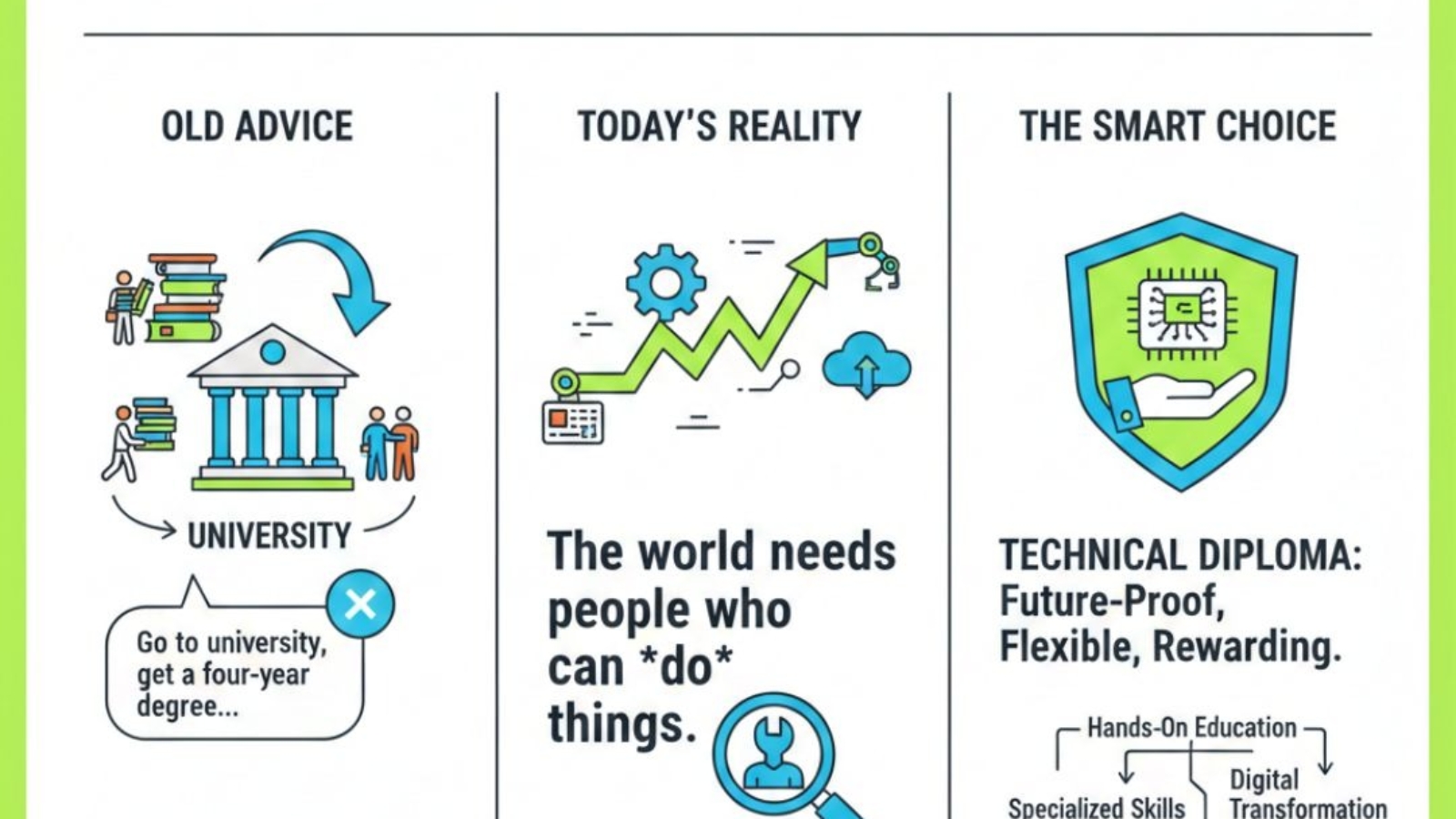
We have all heard the old advice. For decades, parents and teachers repeated the same mantra: “Go to university, get a four-year degree, and your future is set.” For a long time, that was the safest path. But if you look around today, the world feels different. Technology is moving at a breakneck speed, industries are shifting overnight, and the job market is no longer looking for people who just “know” things; it is looking for people who can *do* things.
This is where the **Technical Diploma** comes in. As we are going through the complex era of Digital Transformation, the value of specialized, hands-on education is skyrocketing. It is no longer the “Plan B” for those who didn’t go to university. Instead, it is becoming the smart, strategic choice for anyone who wants a career that is future-proof, flexible, and financially rewarding.
In this piece of writing, we are going to break down why a technical diploma might just be the most valuable asset you can own right now, and how it fits perfectly into our modern, digital world.
The Speed of Tech vs. The Speed of Degrees
Imagine you buy a brand-new smartphone. It’s the latest model, incredibly fast, and has all the best features. Now, imagine you put that phone in a drawer and don’t touch it for four years. When you finally take it out, is it still the best? Probably not. The apps won’t run properly, the operating system is outdated, and the camera quality lags behind the new standard.
This is the challenge facing traditional four-year degrees today. By the time a curriculum is approved, textbooks are written, and students complete their freshman through senior years, the technology they studied in their first semester might already be obsolete.
Technical diplomas operate differently. They are like software updates; fast, targeted, and designed to fix immediate problems. For you, this means you enter the workforce with skills that are fresh and in demand right now, not skills that were relevant five years ago. You aren’t learning the history of the engine; you are learning how to fix the electric motor that Tesla just released.
Employers Are Craving “The Doers”
There is a concept in the corporate world known as the “skills gap.” It sounds like fancy business jargon, but it is actually a very simple problem. Companies have plenty of open jobs, and there are plenty of unemployed people, but the two aren’t matching up.
Why? Because employers are struggling to find people who can hit the ground running.
When a company is going through a digital transformation, perhaps moving their data to the cloud or automating their manufacturing line, they don’t necessarily need someone who can write a ten-page thesis on the theory of cloud computing. They need someone who knows how to configure the server, troubleshoot the network, or program the robotic arm.
A technical diploma focuses entirely on application. It strips away the electives and general education requirements that, while enriching, don’t help you troubleshoot a server crash on a Tuesday morning. This practical approach makes diploma holders incredibly attractive to hiring managers. When you walk into an interview and can show a portfolio of projects you have actually built, fixed, or designed, you instantly have an edge over a candidate who has only studied the theory.
Agility in a World of AI and Automation
One of the biggest fears people have today is Artificial Intelligence (AI). We see headlines claiming that robots will take our jobs. While it is true that AI can write basic emails or generate images, it cannot easily replace the hands-on, nuanced work of a skilled technician.
Digital transformation isn’t about replacing humans; it’s about humans working *alongside* advanced technology.
Think about a modern hospital. They use incredibly complex, automated MRI machines and digital record systems. But who maintains those machines? Who troubleshoots the software when it glitches during a scan? Who secures the patient data against hackers?
Technical diplomas position you to be the person who manages the technology. When you learn a trade or a specific technical skill, you become the bridge between the digital tool and the real world. Automation requires *more* maintenance, *more* programming, and *more* cybersecurity oversight, not less. By securing a diploma in these fields, you are essentially “robot-proofing” your career. You become the master of the machine, rather than the person the machine replaces.
The Flexibility to Pivot
The days of having one career for 40 years are gone. In the digital age, you might change careers five or six times. You might start in web development, move into user experience (UX) design, and eventually transition into digital project management.
Because technical diplomas are shorter and more focused, they allow for “stackable credentials.” This is a strategy where you don’t commit to a massive block of education all at once. Instead, you get a diploma, enter the workforce, and learn. Three years later, you notice the industry is shifting toward data analytics. You can go back, take a six-month specialized diploma in analytics, and pivot your career without having to start a whole new four-year degree.
However, this fast-paced lifestyle of continuous learning and career shifts requires high emotional intelligence. When you are constantly adapting to new roles or upgrading your skills while working, it is easy for the lines between “professional growth” and “personal time” to blur. Learning the art of setting personal boundaries at work is essential during these transitions to ensure that your drive to stay relevant in the digital age doesn’t lead to exhaustion.
This approach allows you to build a career that looks like a Lego set; adding pieces as you go, based on what the market needs and what you enjoy. It is a much more natural way to navigate a working life that is constantly being disrupted by new technologies.
It’s Not Just About “Tech” Jobs
When we say “Technical Diploma,” most people immediately think of coding or IT support. While those are huge parts of it, digital transformation has touched *every* industry.
- Healthcare: Medical tech is booming. We need technicians to operate 3D printers for prosthetics, manage telehealth platforms, and maintain diagnostic equipment.
- Automotive: Mechanics aren’t just changing oil anymore; they are essentially computer engineers working on electric vehicles with millions of lines of code.
- Construction: Modern drafting is done with CAD software and 3D modeling. Green energy requires certified technicians for solar and wind installation.
- Creative Arts: Graphic design, video editing, and sound engineering are all technical fields that rely on complex software suites.
A technical diploma is the key to unlocking these modern versions of traditional roles. It provides the specific digital fluency required to operate in these updated industries. For further reading on how industries are evolving, the Harvard Business Review frequently discusses the changing nature of work and the skills required.
Breaking the “University or Bust” Stigma
For a long time, there was a stigma that vocational or technical education was “lesser than.” Society pushed the narrative that smart people go to university, and everyone else goes to trade school.
The digital age has shattered that illusion. Today, some of the smartest, most successful people are those who bypassed the traditional route to focus on specialized skills. In the tech world, nobody cares about your pedigree; they care about your repository. In the creative world, nobody asks for your transcript; they ask for your portfolio.
We are seeing a cultural shift where “competence” is valued over “credentials.” Large companies like Google, Apple, and IBM have even removed college degree requirements for many of their top positions. They are looking for skills, and a technical diploma is often the most direct proof that you possess them.
Final Thoughts: Your Future is Practical
The world is noisy and confusing right now. Technology changes every day, and it can feel overwhelming to decide what path to take. But if you strip away the noise, the answer is often quite simple: **Learn a skill that solves a problem.**
That is the essence of the technical diploma. It is grounded in reality. It is a commitment to learning something tangible, useful, and immediately applicable. In an age of digital transformation, where everything is becoming virtual, the value of the person who can actually build, fix, and maintain the systems we rely on has never been higher.
So, if you are standing at a crossroads, wondering if a shorter, specialized education is “enough,” stop worrying. It is not just enough; it might be the smartest move you can make. It is your golden ticket to a career that is resilient, adaptable, and ready for whatever the future holds.
By: Muhammad Arif Hossain